
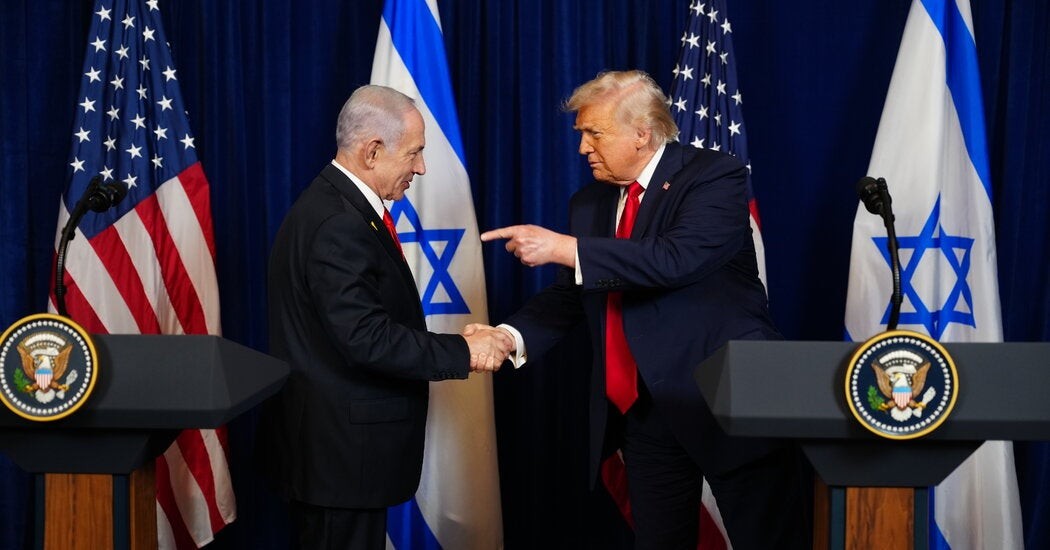
The president’s announcement on Election Day, which he said was part of an agreement reached months ago, was a sign of how quickly the politics surrounding Israel have shifted.
President Trump said on Tuesday that the bulk of American aid to Israel would be “cut off at the end of the year,” under an agreement reached with Prime Minister Benjamin Netanyahu months ago. He described the Election Day declaration chiefly as a political effort to take a “bad talking point” away from the left wing of the Democratic Party.
“We were giving them $4 billion,” Mr. Trump told Brian Kilmeade of Fox News in a morning interview, just as polls were opening on the East Coast. “We are. But it gets cut off at the end of the year.”
Instead, he described a different agreement in which the United States would continue selling weaponry to Israel. But he said Israel would pay for it.
Mr. Netanyahu has spoken in recent months about moving away from aid from the United States but has not laid out a timetable. Mr. Trump’s comments appeared to recognize that it would be extraordinarily difficult to get new aid packages through Congress, and perhaps impossible after Tuesday’s election. But he never actually mentioned Gaza or the remarkably rapid erosion of support for Israel in the United States amid its actions in the three years since the Oct. 7, 2023, terrorist attacks.
“They don’t need it,” Mr. Trump said of the American aid, “and because why should we suffer the slings from lunatics like an El-Sayed when they don’t need it?” he said, a reference to Dr. Abdul El-Sayed, the Democratic candidate for an open Senate seat in Michigan, who has been among the most openly critical of Israel.
“It’s a bad talking point,” Mr. Trump said. He went on to add “Israel’s our No. 1,” but a “thriving country.”
Mr. Netanyahu had his own reasons to get out of the arrangement: Control over aid to Israel has increasingly become a cudgel for those in Congress trying to compel Israeli government action. If Israel were to receive American armaments through more traditional military sales, or as part of a trade and technology agreement, the process could become less of a ritualized battle in Congress — though congressional oversight would not end.
The timing of Mr. Trump’s statement was remarkable: Just as polls opened in the United States, a Republican president was walking away from what has become a mainstay of American foreign policy for decades. Mr. Netanyahu’s office did not immediately comment on the president’s statement, and it is bound to come up as Mr. Netanyahu attempts to form a government after an inconclusive election in Israel last week.


